Offer, reject in writing
Michigan coverage menu: three required parts, one medical limit you choose
Michigan's no-fault law makes every policy carry personal injury protection, property protection and liability. Since July 2, 2020 you pick the PIP medical limit and can sign for lower liability limits. Uninsured motorist coverage is your choice.
By CoverOath Editorial Team Updated 6 min read
The promise, in short
Every Michigan policy must carry personal injury protection (PIP), property protection insurance (PPI) and residual liability. Liability starts at $250,000 per person and $500,000 per crash unless you sign a state form for less, down to 50/100. You choose the PIP medical limit from six levels, and some levels depend on your health coverage. Uninsured and underinsured motorist coverage are optional. The Department of Insurance and Financial Services (DIFS) takes questions at 833-275-3437.
- Minimum liability
- 50/100/10 by signed form
- PIP
- Required, choose a level
- UM/UIM
- Optional
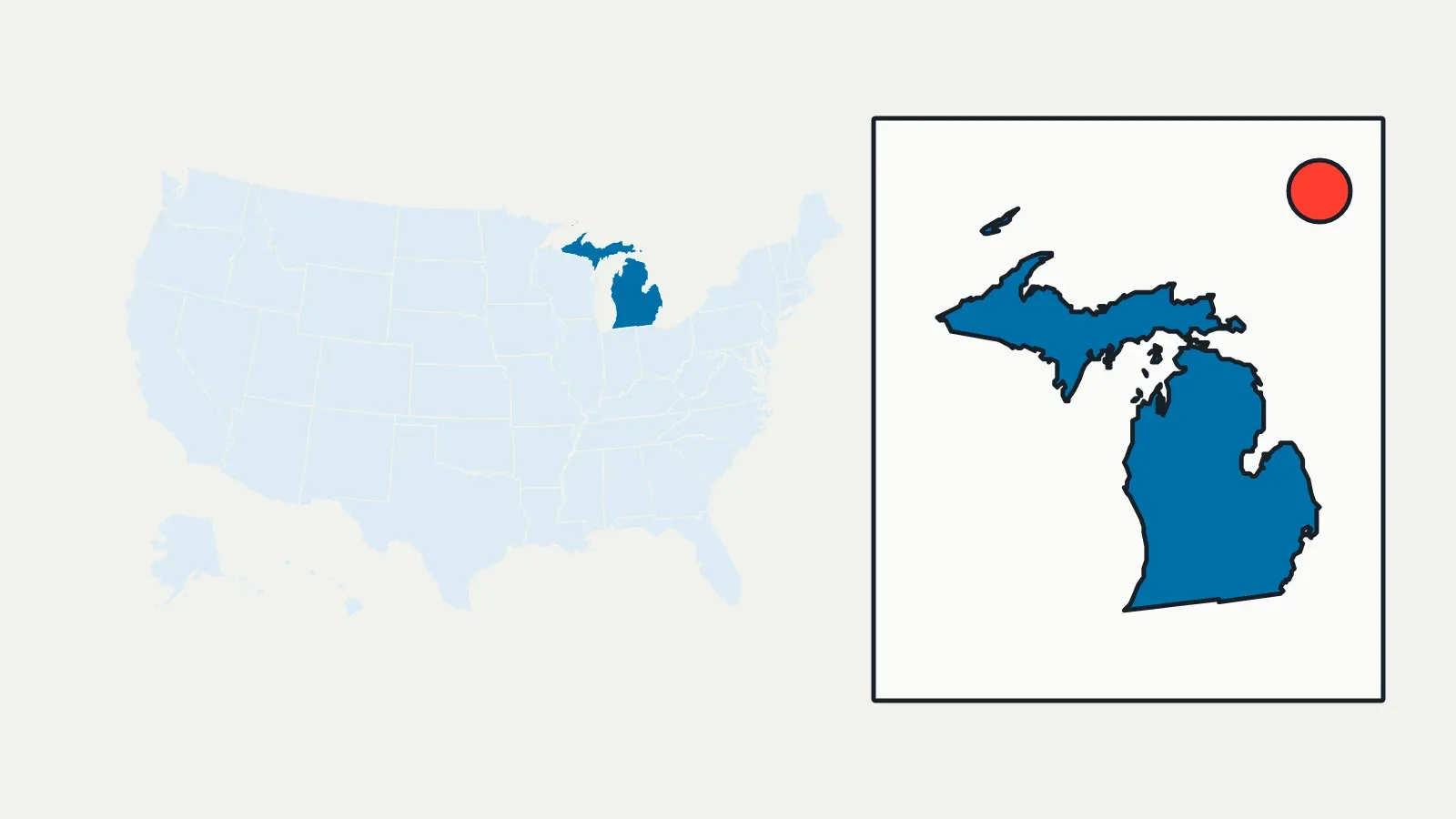
Michigan coverage menu
What a Michigan policy must carry
Michigan law requires the owner of a registered car to keep three coverages in force: personal injury protection, property protection insurance and residual liability insurance (MCL 500.3101). Each one answers a different question. PIP pays injuries. PPI pays for property your car damages in Michigan. Liability pays when you are sued for serious injuries or for crashes outside the state.
| Coverage | Default limit | Lowest by signed form |
|---|---|---|
| Bodily injury, per person | $250,000 | $50,000 |
| Bodily injury, per accident | $500,000 | $100,000 |
| Property damage liability | $10,000 | $10,000 |
| Property protection (PPI) | Up to $1 million | Not reducible |
The 250/500 limits are the default for policies issued after July 1, 2020. You can buy less, but only on a form issued by the DIFS director that carries a written warning and your signature. If no form is signed, the policy carries 250/500. The liability limits page explains how people choose a number.
PIP and the six medical levels
PIP pays medical bills and other benefits after a crash, whoever caused it. Since the 2019 reform you choose the medical limit per person per accident. DIFS lists these levels:
- Unlimited, open to all drivers.
- $500,000, open to all drivers.
- $250,000, open to all drivers.
- $250,000 with exclusions for household members with qualified health coverage (health coverage that is not Medicare).
- $50,000, only if the applicant or named insured is enrolled in Medicaid and other household members have qualified health coverage, Medicaid or their own PIP.
- No PIP medical, only if the applicant or named insured has Medicare Parts A and B and other household members have qualified health coverage or their own PIP.
Property damage in Michigan
PPI pays up to $1 million for damage your car does in Michigan to other people's property, such as buildings and fences, according to DIFS. It is not the coverage that fixes cars in an ordinary two-car crash. For your own car you need collision coverage.
If another driver is mostly at fault, Michigan lets you sue for damage to your car that insurance does not pay, up to $3,000 for crashes after July 1, 2020 (MCL 500.3135). This is the "mini-tort" claim. Insurers usually sell limited property damage liability as an option to pay mini-tort claims made against you.
The $10,000 property damage liability limit in the table is a separate line. DIFS's consumer guide describes it as coverage for property damage you cause outside Michigan, where PPI does not apply.
Optional coverages Michigan drivers add
- Collision and comprehensive for your own car. A lender or lease company will require both for as long as the loan or lease runs.
- Limited property damage liability for mini-tort claims made against you.
- Uninsured and underinsured motorist coverage, described below.
- Add-ons such as rental reimbursement and gap coverage on a financed car.
Uninsured and underinsured motorist coverage
Michigan's no-fault law does not require uninsured motorist coverage and does not set a rule for rejecting it. DIFS lists uninsured and underinsured motorist coverage among the coverages you can choose to buy on top of the required no-fault package. If you skip them and the driver who hurt you has no insurance or low limits, PIP pays your benefits at the level you chose, and any claim above that runs only against the driver personally.
No Michigan statute addresses stacking. Limits, stacking and any hit-and-run conditions come from the policy wording, so read the uninsured motorist endorsement itself. How stacking works explains the idea.
Where to check and complain
- Read your declarations page for your PIP level, liability limits and any UM/UIM coverage.
- Ask for the signed forms if your liability is below 250/500 or your PIP is below unlimited.
- Call DIFS at 833-ASK-DIFS (833-275-3437), weekdays 8 a.m. to 5 p.m., if an insurer will not explain a coverage.
Questions drivers ask
What is the minimum car insurance in Michigan?
PIP at a level you choose, PPI up to $1 million and liability of $250,000/$500,000/$10,000. You can sign a state form to lower bodily injury liability to $50,000/$100,000.
Can I opt out of PIP in Michigan?
Only the PIP medical part, and only if you have Medicare Parts A and B and everyone else in the household has qualified health coverage or their own PIP. Ask your insurer what the policy still includes after that choice.
Is uninsured motorist coverage required in Michigan?
No. It is optional. Ask your insurer for UM and UIM limits if you want them on the policy.
What is mini-tort?
A claim against an at-fault driver for up to $3,000 of damage to your car that your insurance does not pay. Limited property damage liability coverage pays such claims made against you.
Drawn from
- Michigan DIFS — Auto insurance frequently asked questions (PIP levels, 250/500 default, PPI)
- Michigan Compiled Laws §500.3101 (required security)
- Michigan Compiled Laws §500.3009 (liability limits and lower-limit form)
- Michigan Compiled Laws §500.3135 (mini-tort, $3,000)
- Michigan DIFS — Information on purchasing auto insurance (optional coverages)
- Michigan DIFS — Contact DIFS about auto insurance (833-ASK-DIFS)
Facts on this page were checked against these sources on November 15, 2026. The PIP choice, the 250/500 default liability limits and the $3,000 mini-tort cap apply to policies issued and crashes occurring after July 1, 2020.
Have this coverage priced
CoverOath doesn't sell insurance. Answer five questions and CoverOath passes your request to licensed insurance agents and insurers, who can quote the coverage; you decide whether to buy anything.
- 1 The coverage you want priced.
- 2 Where an agent can reach you, and your consent.
- 3 A licensed insurance agent or insurer contacts you with a quote. Nothing is bought until you agree.
CoverOath is not paid by you. The licensed insurance agents and insurers who contact you set their own prices and terms. How we make money.
Adjacent layers
-
Core coverage
Personal injury protection (PIP)
Pays medical bills and lost income whoever caused the crash. Mandatory in the 12 no-fault states.
-
Core coverage
Bodily injury liability
Pays other people's injury claims when you cause a crash, up to a per-person and a per-accident limit.
-
Core coverage
Uninsured motorist coverage (UM)
Pays your injuries when an uninsured or hit-and-run driver is at fault. Required in about 20 jurisdictions.